Why the future of design won’t be about making screens — but saving products
There’s an old joke in design circles:
Design is the only profession where everyone in the company thinks they’re a designer.
The founder has opinions.
The sales team has opinions.
The intern has opinions.
The client’s cousin somehow has opinions.
And now, thanks to AI, everyone suddenly has output too.
Not taste. Not judgement. Not systems thinking. Output.
What’s services and costing will look like going forward.
- AI made the UI — free
- AI made the UI, we clean it — $1500
- AI made the UI, we fix UX — $3000
- AI made the UI, we redesign — $5000
- AI made the product, we save it — $10,000
Funny? Yes.
Accurate? Uncomfortably.
Because that’s exactly where we’re headed.
The Future of Design Isn’t Threatened by AI. It’s Exposed by It.
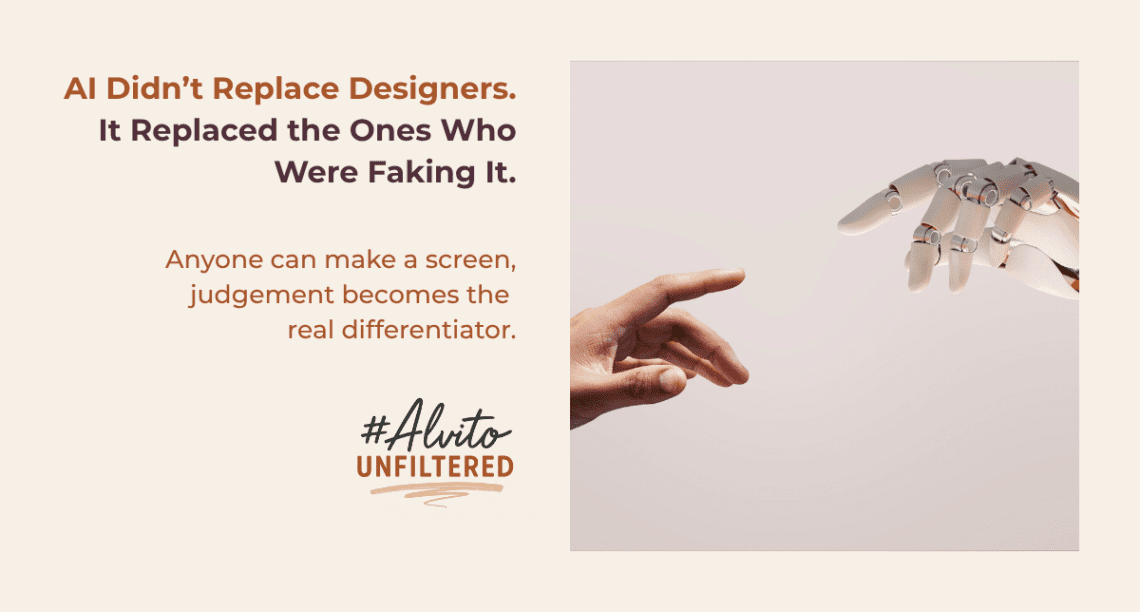
AI is not replacing design. It’s exposing how much of what we called design was actually just production.
Layouts.
Mockups.
Button placements.
“Can you make it pop?”
“Try a cleaner font.”
“Add a gradient.”
That work isn’t disappearing because design is dead.
It’s disappearing because it was never the highest-value part of design to begin with.
AI can generate a screen.
What it can’t reliably do is understand:
- why the screen exists
- what user tension it needs to resolve
- where the business model breaks
- why people abandon the journey halfway
- what needs to be simplified, removed, repositioned, or completely rethought
That’s not UI work. That’s product judgement. And that’s where the future is.
The Real Value of Design Was Never the Interface
It was the ability to see what others were missing.
Good designers don’t just make things look better.
They make things make sense.
- They reduce friction.
- They expose weak assumptions.
- They challenge bloated features.
- They translate chaos into clarity.
In the AI era, that becomes even more valuable.
Because when everyone can generate something,
the real differentiator becomes knowing what should exist in the first place.
That’s a very different skill set.
The Job Is Shifting from “Make It” to “Fix It”
For years, designers were brought in to execute.
“Here’s the brief.”
“Here’s the content.”
“Here’s the product roadmap.”
“Make it look premium.”
But the next wave of value won’t come from decorating decisions made by other people. It will come from stepping in earlier and asking better questions:
- Should this feature even exist?
- Is this journey solving the right problem?
- Are we designing for user need or internal politics?
- Is the friction in the interface — or in the business model itself?
- Are we building a product, or just shipping screens?
That’s the difference between a designer who arranges pixels and one who protects the product from bad thinking.
One is a service. The other is leverage.
AI Will Democratise Design Output. Good.
That’s not a threat. That’s a filter.
When everyone can produce decent-looking UI in seconds, surface-level design becomes cheaper, faster, and less defensible.
Which means the bar moves.
The future designer won’t be measured by how fast they can make a homepage mockup.
They’ll be measured by:
- how clearly they think
- how deeply they understand behaviour
- how well they simplify complexity
- how early they spot the real problem
- how much business waste they can prevent before it ships
That’s not just design. That’s strategic intervention.
Forseeing the Future? Start Here.
If you’re a designer, this is not the moment to panic.
It’s the moment to upgrade.
Stop obsessing over whether AI can generate prettier UI.
Start asking whether you can become the person who:
- improves the product, not just the page
- sharpens the strategy, not just the style
- challenges the brief, not just executes it
- protects the user and the business from expensive mediocrity
Because the future won’t belong to the designer who can make the best screen.
It’ll belong to the one who can walk into a messy product, a confused brand, or a bloated user journey and say:
“This isn’t a design problem. This is where the real problem is.”
And then fix that. That’s not UI. That’s value.
And value, unlike aesthetics, doesn’t get automated so easily.
Closing Thought
AI didn’t kill design. It just removed the hiding place.
Now we get to see who was making interfaces…
and who was actually shaping outcomes.
The future belongs to the second kind.
#ArtificialIntelligence #ProductThinking #DesignLeadership #DesignThinking #ProductStrategy #UXDesign #Innovation #Leadership #FutureOfDesign #AlvitoUnfiltered